Teen Phone Addiction: Signs, a Quick Test and What Helps

Teen phone addiction shows up when the phone starts to matter more than sleep, friends and school: your child can't put it down, gets angry when you take it away and keeps scrolling long after lights out. Younger kids can get hooked on screens in the same way. It isn't an official diagnosis, and a lot of phone use is normal for teens, but the effects on sleep, mood and grades are real. Below are the signs to watch for, a quick 10-question test, what actually helps and how to see how much your child really uses the phone, including at night.
See how much your teen really uses the phone, hour by hour
KidInspector shows the time spent in each app and hourly activity on your child's Android phone, Windows PC and Mac, including after 10 p.m. Creating an account is free.

What is phone addiction, and what is nomophobia?
Doctors and researchers usually talk about "problematic smartphone use" rather than addiction: phone use a child can no longer control and that pushes out other things. Nomophobia, short for "no-mobile-phone phobia", is the anxiety some people feel when they are without their phone. The term comes from a 2008 UK study of mobile phone users. Neither is a formal diagnosis. The one related condition the World Health Organization does recognize is gaming disorder, added to its classification in 2019, and it sometimes overlaps with heavy phone use.
For a parent, the label matters less than one question: is the phone taking sleep, friends, school or peace of mind away from my child?
Signs of phone addiction in teens and kids
- Restless without the phone: your child gets anxious or irritable when the phone is lost, the battery dies or you take it away.
- Losing track of time: "five more minutes" turns into two hours.
- Night-time use: they scroll in bed, wake up to answer messages and are exhausted in the morning.
- Dropping hobbies: sports, friends in real life and things they used to love fade into the background.
- Slipping grades or trouble focusing on homework.
- Hiding it: they lie about screen time or use the phone when they think no one is watching.
- Constant checking: they unlock the screen dozens of times a day without any notification.
- Daily fights about time limits.
In younger kids, screen addiction often looks like meltdowns when the tablet or phone is switched off, asking for it first thing in the morning and losing interest in play without a screen.
Is my teen addicted to their phone? A 10-question test
Answer yes or no, thinking about the last four weeks. This isn't a diagnosis, just a way to sort out what you are seeing.
- Does your child use the phone in bed after lights out?
- Do they get very angry when you ask them to put the phone down?
- Do they go over the agreed screen time almost every day?
- Have they given up activities they used to enjoy?
- Do they look at the phone during family meals?
- Do they get anxious when the battery or data runs out?
- Have their grades or concentration got worse?
- Are they sleeping less or struggling to get up in the morning?
- Have they lied to you about how long they spend on the phone?
- Is checking the phone the first thing they do after waking up?
0–3 yes: typical use, keep your routines. 4–6: agree on clear limits and look closely at night-time use. 7 or more: have a calm talk with your child and, if you also see anxiety, withdrawal or serious sleep problems, speak to your pediatrician.
How much screen time is too much?
The WHO recommends no sedentary screen time for children under 2 and no more than one hour a day for ages 2 to 4. For older kids and teens there is no magic number, and the American Academy of Pediatrics suggests a family media plan built around your child's age and routine instead of one fixed limit. What matters most is what your child does on the phone, at what time and what it replaces. The U.S. Surgeon General's 2023 advisory on social media noted that teens who spend more than three hours a day on social media face double the risk of depression and anxiety symptoms. Two hours of chatting with friends in the afternoon is not the same as two hours of short videos at 1 a.m.
How to break screen addiction in kids: what actually helps
- The phone sleeps outside the bedroom. This one rule has the biggest effect: it protects sleep and ends night-time use.
- Set the limits together. Teens stick to rules they helped agree on far better than to rules imposed on them.
- Phone-free zones: meals, homework and the first hour of the day.
- Fewer notifications. Turn off the ones from social media and games; leave calls and messages from family.
- Real alternatives. Sports, meeting friends, activities your child enjoys. Taking the phone away without offering anything instead doesn't work.
- Lead by example. If you check your phone at the dinner table, so will your child.
- Use technical limits as support. Tools help everyone stick to the agreement; they don't replace the conversation.
How to see your child's real screen time and night-time use
Parents almost always underestimate or overestimate screen time. Real numbers change the conversation: instead of "you're always on your phone" you can say "on Tuesday you were on TikTok for two hours after midnight". KidInspector works on Android, Windows and Mac. It doesn't work on iPhone.
- Create a KidInspector account and install it on your child's phone or computer. Tell your child it's on and why.
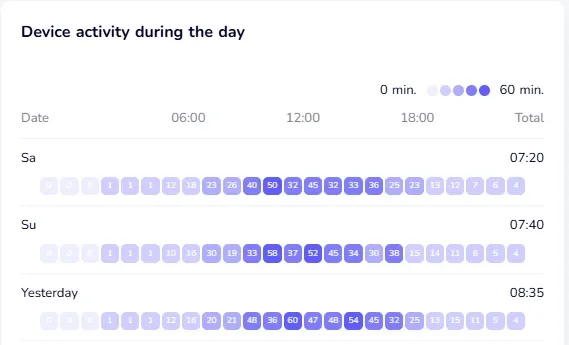
- Open Device statistics. You see daily screen time, the most-used apps and each day's activity hour by hour, so you can tell at a glance whether the phone is being used at night.
- Look at each app. On an app or game page you see time spent, sessions and night-time use between 10 p.m. and 6 a.m.
- Set limits where needed. You can block apps on Android and Mac and websites on all three systems. Every attempt to open them is logged.
Open Device statistics in the demo
Daily screen time, most-used apps and hourly activity on sample data, exactly as a parent sees them. The demo opens without signing up.
When to get help
Talk to your pediatrician, a school counselor or a child therapist if phone use comes with lasting sadness, withdrawal from friends and family, serious sleep problems, angry outbursts or a sharp drop in grades, or if your child wants to cut down and can't. The earlier you act, the easier it is.
Read also
- How to Check Screen Time on Android (Samsung, Pixel, Xiaomi)
- Is Discord Safe for Kids? Risks and Parental Controls Explained
- How to Block Websites on Chrome (Windows, Mac & Android)
Frequently asked questions
No. Experts describe it as problematic smartphone use, which can still affect sleep, mood and school performance. Gaming disorder is the only related condition the WHO recognizes officially.
There is no single number. Rather than counting hours, look at whether your teen sleeps well, still does sports, sees friends and keeps up at school. Phone use late at night is the clearest warning sign.
Usually not much, and it leads to fights. Agreed rules, the phone outside the bedroom at night and real alternatives work better.
With a tool like KidInspector on Android, Windows or Mac you see each day's activity hour by hour and every app's use between 10 p.m. and 6 a.m.
Yes, the same patterns show up with tablets and phones in younger children. Short, predictable screen times, no screens before bed and plenty of offline play help most.
Set limits you can both stick to
KidInspector shows time and night-time use for every app, blocks apps on Android and Mac and websites on Android, Windows and Mac, and logs every attempt to open them. Creating an account is free.