
Teen Dating Apps: What Parents Need to Know
Teen dating apps don’t exist among the mainstream names: Tinder, Bumble and Hinge are 18+. But teens meet strangers on Wizz, Hoop, Snapchat, Discord and Instagram. See each app’s age rules and age checks, the risks and warning signs, how to talk with your teen and how to block dating apps on Android and iPhone.

Teen dating apps don’t exist among the mainstream names: Tinder, Bumble and Hinge all require users to be at least 18. Teens still meet strangers, though, through friend-finding apps such as Wizz and Hoop, Snapchat’s friend suggestions, Discord servers and Instagram DMs, where fake profiles, predators and sextortion are the main risks.
This guide covers each app’s age rules, warning signs, conversation tips and how to block dating apps.
Are there dating apps for teens?
Not among the mainstream apps. Tinder’s help center, Bumble’s terms and Hinge’s help pages all set the minimum age at 18. Age checks depend on location: Tinder says verification is required only in some places (face scans, ID or, in Texas, an app-store age range), and Hinge requires a face photo for age estimation in the EU, the UK, Australia and Brazil. So a teen with a fake birth date may get through, into a space meant for adults. NCMEC, the US National Center for Missing & Exploited Children, says lying about age to get onto platforms can increase a child’s risk.
What parents may find instead are friend-finding apps that borrow dating-app mechanics: swiping through strangers’ profiles, matching and chatting.
Apps teens use to meet people
Minimum ages come from each app’s terms or help pages; ratings are from the US app stores.
| App | Minimum age | Age verification | Main risk |
|---|---|---|---|
| Tinder, Bumble, Hinge | 18 | Face scan, ID or app-store age range in some locations | A teen with a fake birth date chatting with adults |
| Yubo | 18 | Facial age estimation at sign-up, ID check when needed | Adults-only app; teens are no longer allowed |
| Wizz | 16 | Yoti facial age estimation and date-of-birth check; ID if the age doesn’t match | Swiping and chatting with strangers |
| Hoop | 13 | Date of birth entered at sign-up | Usernames swapped to move chats to other apps |
| Snapchat | 13 | Self-declared age; Snap may ask for verification | Strangers added through Quick Add or shared usernames |
| Discord | 13 | Age estimated from account signals; face scan or ID to confirm an adult | Strangers from large servers moving to DMs |
| 13 | Birth date plus AI checks for teens; ID or face scan to switch to 18+ | Fake profiles in DMs; sextortion |
Yubo: now 18+ only
Is Yubo safe for teens? Teens are no longer allowed on it. Yubo used to accept users from 13, but it has closed its under-18 accounts, and its support site says: “We definitely don’t allow users under 18.” The App Store rates it 18+, Google Play Mature 17+. Report an underage profile by tapping the shield icon on it in the app.
Wizz: swipe to chat, 16+
Wizz lets users swipe through profiles and chat with people worldwide. Its terms set the minimum age at 16. Its Safety Hub says every user completes Yoti facial age estimation and date-of-birth checks, ID is requested when an age mismatch is detected, and “users are only ever connected with peers their own age.” The App Store rates it 18+, Google Play rates it Teen.
Apple and Google both pulled Wizz for a time; NBC News reported that Apple acted after the National Center on Sexual Exploitation, a US advocacy group, raised sextortion concerns. Wizz says it was reinstated after meeting the stores’ safety standards. Australia’s eSafety Commissioner warns it “can potentially match adults with children,” and the Welsh Government’s Hwb guide notes frequent prompts to buy coins and subscriptions.
Hoop: collecting usernames
Hoop lets users send friend requests to profiles they like and then, in its App Store wording, “add them on your social apps.” Its terms set the minimum age at 13, with parental permission required under 15. Hoop’s safety page says teens and adults are kept apart automatically, teen profiles are private by default and “Minors do not have access to chat on Hoop.” The App Store rates it 13+. The risk: once usernames are swapped, the chat moves to Snapchat or another app, beyond Hoop’s age filter.
Snapchat Quick Add
Quick Add is Snapchat’s list of suggested friends. Snap says 13- to 17-year-olds must have several mutual friends with someone before appearing in their search results or friend suggestions, and teens see a pop-up warning when adding someone with no mutual friends. Snap also says teens can’t be messaged by anyone they haven’t added as a friend or have in their phone contacts. The catch: once your teen adds someone, say after swapping usernames on Hoop, that person can message them. It’s rated 13+ on the App Store and Teen on Google Play.
Discord and Instagram
Both set the minimum age at 13 in the US and are rated 13+ on the App Store and Teen on Google Play. Discord says teen accounts now get protections by default: messages from non-friends go to a message requests inbox, teens are warned about friend requests from people they share no mutual friends with, and lifting the DM filter requires confirming you’re an adult. Instagram’s Teen Accounts are private by default, teens can only be messaged by people they follow or are connected to, and under-16s need a parent’s permission to loosen these settings. Meta says it uses AI to find suspected teens who list an adult birthday and move them into Teen Accounts.
Apps not built for meeting people can have private messages too, like the 18+ short-video Scoopz app.
Risks: fake profiles, predators, sextortion, meeting in person
Fake profiles and catfishing
The FBI says predators often pose as peers with a similar age, shared interests or the same location. In sextortion cases, fake profiles typically look like teenage girls and often seem new, with few followers; some are hacked real accounts or copycat accounts.
Predators and grooming
NCMEC lists common tactics: compliments and shared interests, pretending to be younger, offering gift cards or other incentives, sexual conversation and requests for explicit images. Offenders often ask a child to move to an app with encrypted messaging, so “let’s talk somewhere else” is worth noticing. Our guide on whether Telegram is safe covers one such app.
Sextortion
Sextortion is blackmail with a sexual image, real or faked. The FBI says victims of financial sextortion are “typically males between the ages of 14 to 17” and that it can happen quickly, “sometimes in just five minutes.” In Thorn’s analysis of NCMEC reports, Instagram and Snapchat were the most common platforms, and NCMEC’s latest CyberTipline data show an average of 137 financial sextortion reports a day.
If it happens, don’t pay or send more images. Save the messages, block and report the account, and contact the FBI (tips.fbi.gov or 1-800-CALL-FBI) or NCMEC’s CyberTipline (report.cybertip.org or 1-800-843-5678). NCMEC’s free Take It Down tool helps platforms such as Instagram and Snapchat detect and remove images taken before 18. Tell your child what the FBI tells victims: “You are not alone, and this is not your fault.” In a crisis, call or text 988.
Meeting in person
NCMEC’s NetSmartz advice is to be very careful about meeting offline: get a parent’s permission first, bring a trusted adult, and meet and stay in a public place. Kaiser Permanente suggests researching the person together and planning to attend the first meeting. If a relationship involves pressure or threats, love is respect, the National Teen Dating Abuse Hotline, helps by phone (866-331-9474), text (LOVEIS to 22522) and chat.
Warning signs
None of these proves something is wrong, but they’re worth a calm conversation:
- Spending more and more time online, or getting upset when they’re not allowed on their device (NCMEC red flags).
- Taking extra steps to hide what they do online, or receiving gifts from people you don’t know.
- An app you don’t recognize, or one rated for adults, such as Yubo.
- A new contact with few followers who seems to share all your teen’s interests.
- Requests to switch apps, start a video call or send photos.
- Coin or subscription purchases, or gift card requests, you can’t explain.
How to talk to your teen about online dating
Curiosity works better than a ban. Experts quoted by Internet Matters advise showing interest in all your teen’s relationships, staying calm and talking openly and often about relationships. NCMEC adds that taking away internet access after a mistake doesn’t solve the problem. Three situations:
- You find Wizz on their phone. “I noticed Wizz. What do you like about it? Who have you met there?” Listen first; Kaiser Permanente suggests saying, “My biggest concern is keeping you safe.” Agree on rules together, such as not moving chats to other apps.
- They have an online boyfriend or girlfriend they’ve never met. “How did you meet?” Take it seriously, and agree that any meeting happens in a public place, with your permission and with you or another trusted adult there.
- Someone is pressuring or threatening them. “You’re not in trouble. Thank you for telling me. We’ll handle this together.” Then follow the sextortion steps above.
How to check and block dating apps on your child’s phone
Start by looking at the phone together: which apps are installed and how they’re rated. Apps can be hidden, so see our guide on how to find hidden apps on Android.
Android (Google Family Link): in the Family Link app, select your child, tap Screen time, Time limits, then App limits, pick an app and switch it from Allowed to Blocked. Under Controls and Google Play you can set rating-based restrictions, but Google notes that apps installed earlier stay available until you block them.
iPhone (Screen Time): in Settings, tap Family, your child’s name and Apps & Websites, select an app and tap Block App. With Ask to Buy and Require Purchase Approval on, new downloads need your OK. These labels come from Apple’s current guide and apply when every device in your Family Sharing group runs the latest software.
For more tools, compare the best app blockers for Android.
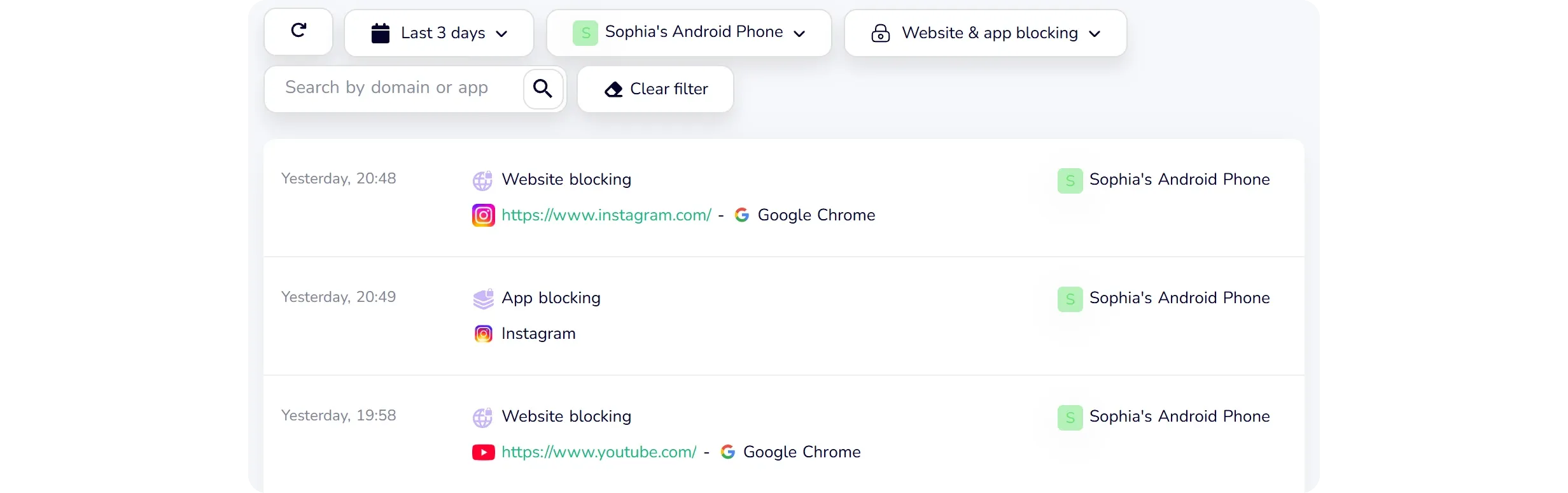
KidInspector shows the apps installed on your child’s Android phone, Windows PC or Mac. On Android and Mac it can block an app such as Wizz and log attempts to open it. It doesn’t work on iPhone. Tell your child it’s there, and what’s blocked and why.
See which apps are on your child’s phone
KidInspector lists installed apps on Android, Windows and Mac, blocks the ones you choose on Android and Mac and logs attempts to open them. Demo opens without sign-up.
FAQ
Yubo now allows only users aged 18 and over and has closed its under-18 accounts. If your teen still has it, they’re on an app built for adults, and you can report the profile to Yubo.
Wizz is a swipe-to-chat app for meeting new people. Its terms set the minimum age at 16, and Wizz says all users go through Yoti facial age estimation. The App Store rates it 18+, Google Play Teen.
No mainstream dating app is meant for under-18s. Some friend-finding apps add age checks, but they still connect teens with strangers, so ongoing conversations and clear rules about meeting in person matter most.
Stay calm and tell your teen it’s not their fault. Don’t pay, save the messages, block and report the account, contact the FBI or NCMEC, and use Take It Down.
Check the full app list together, including hidden folders. Family Link’s App limits list shows the apps on an Android device, and KidInspector lists installed apps on Android, Windows and Mac.
See where their screen time goes
KidInspector shows how long your child spends in each app, including messengers on Android, and which websites they visit, all in one web dashboard. Creating an account is free.