Best App Blockers for Android in 2026
We compared nine app blockers for Android, from Google Family Link and Digital Wellbeing to AppBlock, Qustodio and KidInspector, with prices, free tiers and uninstall protection. Plus how to block or lock apps on Samsung, Xiaomi and Pixel without installing anything.
An app blocker stops an app from opening, either for good or during the hours you choose. Parents use one to keep games and social media off a child's phone at night, and many adults use one on their own phone to stop doomscrolling. The two jobs need different tools: a child's blocker has to be controlled from the parent's phone and survive a determined 12-year-old, while a self-control blocker mostly needs to be hard to switch off in a weak moment.
We compared nine app blockers for Android, free and paid, on the features that matter for each job, and checked prices on the developers' sites and app stores on October 8, 2026. Further down you'll also find how to block apps with nothing but Android's own settings, and how to lock apps with a PIN or fingerprint on Samsung, Xiaomi and Pixel.
What to look for in an app blocker
- Remote control. For a child's phone, you want to change rules from your own phone, not by borrowing theirs.
- Uninstall protection. If the blocker can be deleted in two taps, it isn't blocking anything. Look for a PIN, device admin lock or parent approval to remove it.
- Schedules and limits. Blocking "always" is rarely what you want. Good blockers combine schedules (school, bedtime) with daily limits per app.
- Websites too. Blocking the YouTube or Instagram app is pointless if the same site opens in Chrome.
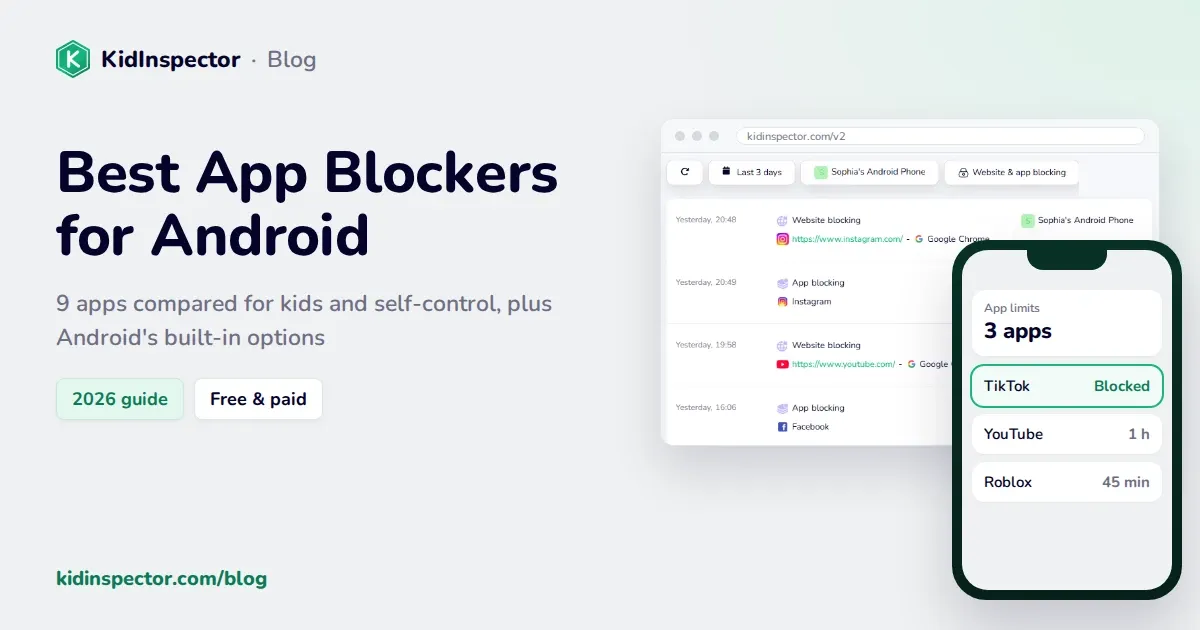
- A log of attempts. Seeing which blocked apps someone tried to open tells you where the real pull is, and whether the rules need a conversation.
- Price and free tier. Several blockers have a usable free tier with limits on how many apps you can block.
Best app blockers for Android
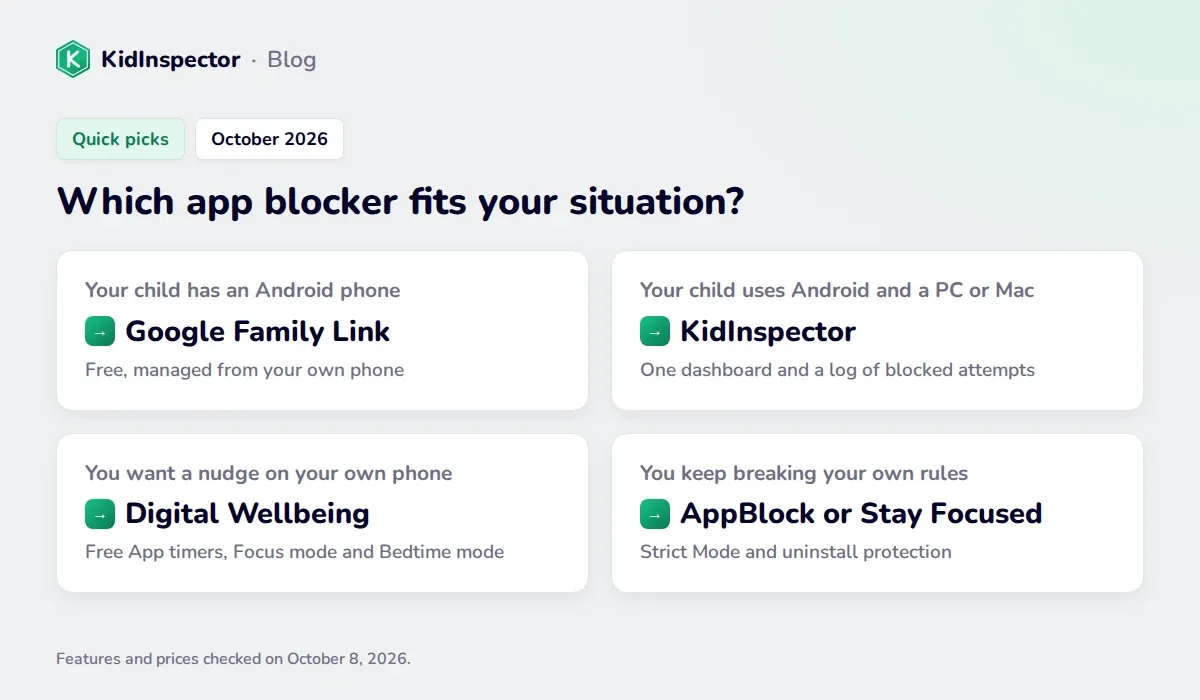
1. KidInspector: app and website blocking with an attempts log
Best for: parents whose kids use an Android phone and a Windows PC or Mac.
KidInspector blocks apps and websites on a child's Android phone, Windows PC and Mac, and you manage everything from one web dashboard. Its most useful feature for blocking is the log: every time your child tries to open a blocked app or site, you see what it was, when, and on which device and browser. It also shows time spent in each app, and on Android, location history and screenshots. Features vary by platform.
- Price: paid; you can try the full dashboard in a demo without signing up.
- Pros: phone and computer under the same rules; attempts log; websites and apps in one place.
- Cons: no iPhone support; not designed as a self-control tool for adults.
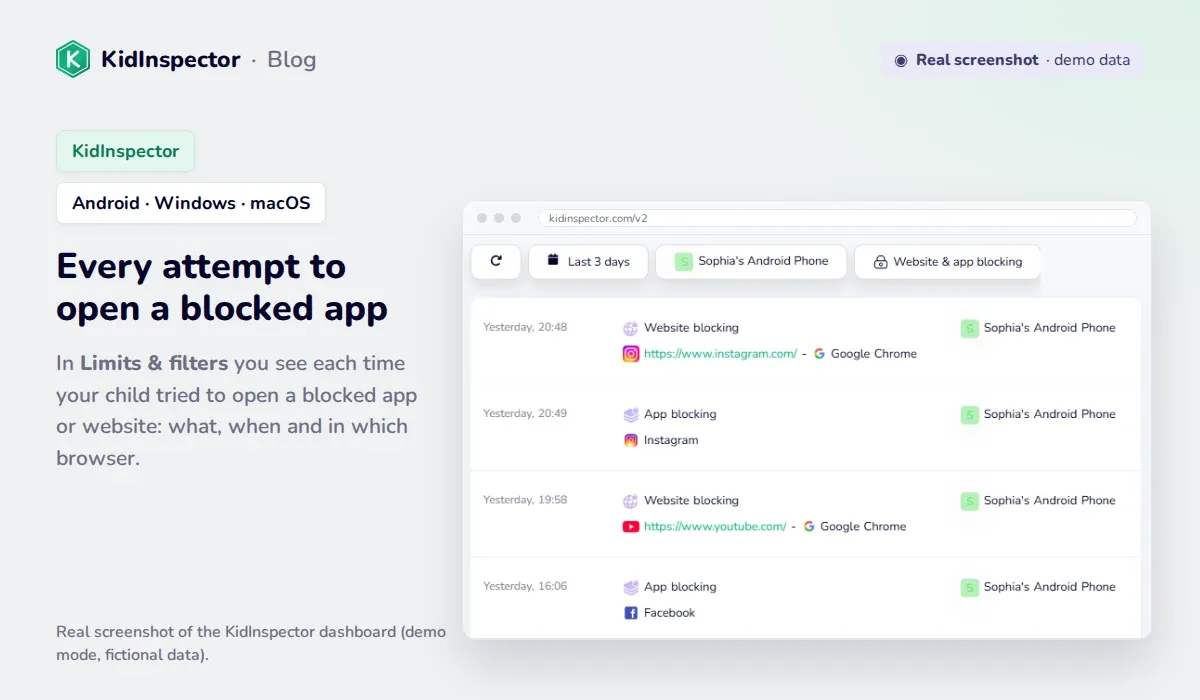
See what they tried to open, not just what you blocked. KidInspector blocks apps and websites on your child's Android phone, Windows PC and Mac, and logs every attempt to open something blocked. Use it on your own devices and your kids' devices, and tell them it's on. iPhone is not supported.
2. Google Family Link: the free default for kids
Best for: kids under 13 with an Android phone, on a zero budget.
Family Link is Google's free parental control app. From your phone (Android, iPhone or the web) you can block any app on your child's Android device, set a time limit per app, require approval for every Play Store download, and lock the phone at bedtime. The child's phone needs Android 7 or later.
- Price: free, no paid tier.
- Pros: built into Android; remote control; your child can't remove supervision without your approval until 18.
- Cons: Android and Chromebook only; no log of blocked attempts; website filtering works in Chrome, so other browsers need to be blocked as apps.
3. Digital Wellbeing: built-in timers for your own phone
Best for: adults who want a gentle nudge, at no cost.
Digital Wellbeing comes with most Android phones. App timers pause an app for the rest of the day once you hit your limit, Focus mode pauses a set of distracting apps on demand or on a schedule, and Bedtime mode turns the screen gray and silences the phone at night.
- Price: free.
- Pros: nothing to install; clear dashboard; works on almost any Android phone.
- Cons: anyone holding the phone can turn it off; no website filter; no uninstall lock. Not a parental control.
4. AppBlock: strict mode for self-control
Best for: adults and older teens who keep breaking their own rules.
AppBlock by MobileSoft blocks apps and websites on Android and iPhone, with browser extensions for Chrome, Edge and Brave. Its Strict Mode locks your settings until a timer or schedule ends, until you enter a PIN, or until the phone is on the charger, and it can add a cooldown or require a partner's approval before you can change anything. It can also prevent uninstalling through Android's device admin.
- Price: free on Android for up to 3 apps, 3 websites and 3 schedules, with Strict Mode up to 24 hours. The paid plan on iPhone in the US is $4.99/month or $29.99/year; Android prices are shown in the app.
- Pros: very hard to bypass in Strict Mode; 10M+ downloads on Google Play.
- Cons: designed for self-control, not for managing someone else's phone remotely.
5. Qustodio: parental control across every platform
Best for: families with many different devices.
Qustodio runs on Android 9+, iPhone (iOS 15+), Windows 10+, macOS, Chromebook and Kindle. Paid plans block apps or set per-app time limits, filter websites, show location and send detailed reports. On Android, the child can't uninstall it without the parent's permission.
- Price: Basic $59.95/year (5 devices), Complete $104.95/year (unlimited devices). The free plan covers 1 device with a web filter, safe search, restricted times and 7 days of reports, but no app blocking or app limits.
- Pros: widest platform support; uninstall protection on Android.
- Cons: app blocking is paid-only; one of the pricier options.
6. FamiSafe: app rules plus location
Best for: parents who want app blocking together with location alerts.
FamiSafe by Wondershare works on Android, iPhone, Windows, Mac, Kindle Fire and Chromebook (via extension). It offers app rules and limits, a web filter, live location, geofences, YouTube controls and keyword alerts in social apps. On Android, removing it requires a password; on iPhone there's no uninstall protection.
- Price: $9.99/month, $19.99/quarter or $59.99/year. The free tier covers 1 device with most features locked.
- Pros: broad feature set; uninstall password on Android.
- Cons: the free tier is too limited to judge it; weaker protection on iPhone.
7. Stay Focused: blocking by keyword
Best for: adults who want fine-grained limits, including keywords.
Stay Focused by Innoxapps blocks apps, websites and keywords, with schedules, daily limits and a Strict Mode that stops you from changing the rules. Uninstall prevention uses Android's device admin.
- Price: on iPhone in the US, $3.99/month, $9.99/quarter or $24.99/year; Android prices are shown in the app.
- Pros: keyword blocking; detailed per-app limits; 5M+ downloads on Google Play.
- Cons: self-control tool, no remote management for parents.
Also worth a look: Lock Me Out and Freedom
Lock Me Out by TeqTic is Android-only and locks you out of chosen apps, or the whole phone, for a set period. Blocking is free; uninstall protection is a premium feature. Freedom blocks apps and sites across Mac, Windows, iPhone, Android and Chromebook at the same time, which suits people who get distracted on every screen. Its free plan has no scheduling or Locked Mode; Premium is $8.99/month or about $39.96/year.
Comparison table
| App | Made for | Remote control | Uninstall protection | Websites | Free tier | Paid price (Oct 8, 2026) |
|---|---|---|---|---|---|---|
| KidInspector | Parents | Yes, web dashboard | — | Yes, with attempts log | Demo | Paid |
| Google Family Link | Parents | Yes | Parent approval until 18 | Chrome only | Fully free | Free |
| Digital Wellbeing | Self | No | No | No | Fully free | Free |
| AppBlock | Self | No | Yes (Strict Mode) | Yes | 3 apps, 3 sites | $29.99/yr (iPhone, US) |
| Qustodio | Parents | Yes | Yes (Android) | Yes | 1 device, no app blocking | $59.95–$104.95/yr |
| FamiSafe | Parents | Yes | Yes (Android) | Yes | 1 device, mostly locked | $59.99/yr |
| Stay Focused | Self | No | Yes (Strict Mode) | Yes, plus keywords | Yes | $24.99/yr (iPhone, US) |
| Lock Me Out | Self | No | Premium | No | Yes | Shown in app |
| Freedom | Self | No | Locked Mode (Premium) | Yes | Yes, no scheduling | ~$39.96/yr |
Prices are in US dollars from the developers' sites or the US App Store. Android in-app prices can differ by country, so check the price in the app before you subscribe.
How to block apps on Android without installing anything
Android 17 Parental controls
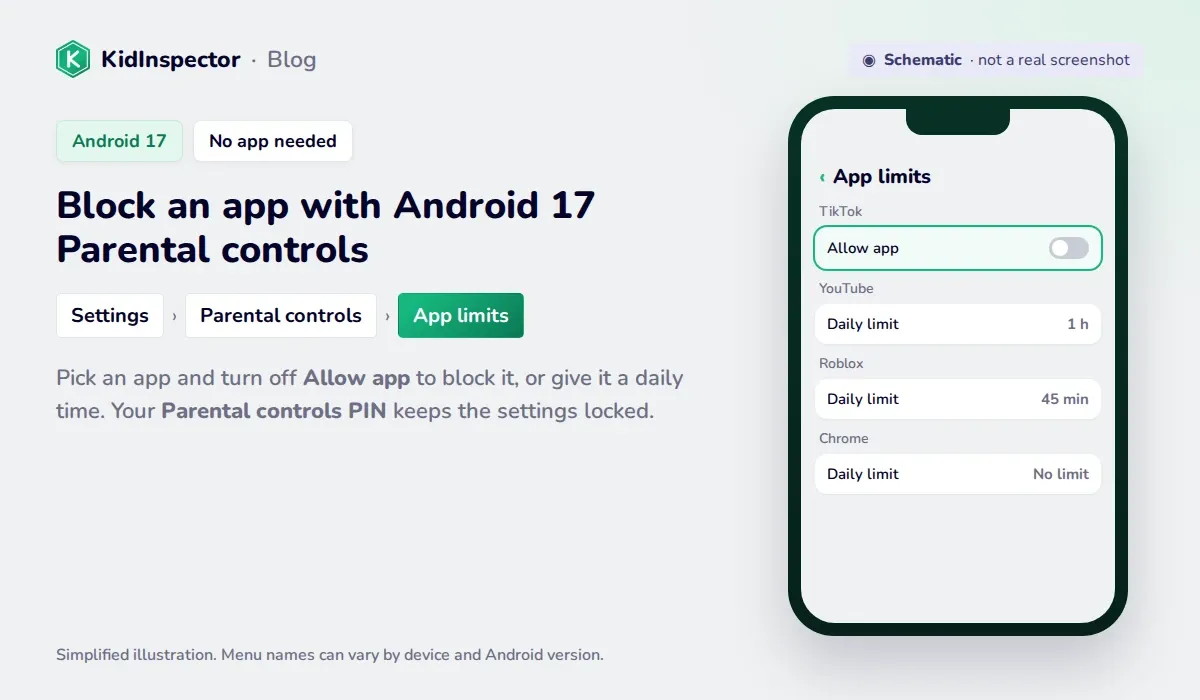
Phones that have updated to Android 17 have parental controls built into Settings, no account needed (Google):
- Open Settings › Parental controls and set a Parental controls PIN of at least 4 digits.
- Go to App limits, pick the app, and turn off Allow app to block it completely, or set a daily time.
- Add a Daily limit for the whole phone and Downtime for the night.
- Turn on Web content filters to block explicit sites in Chrome and the Google app.
It doesn't work if the phone has a work profile or a private space. Add a recovery account when asked: without it, a forgotten PIN means a factory reset.
Digital Wellbeing App timers
On Android 15 and 16, go to Settings › Digital Wellbeing & parental controls, tap the chart, choose an app and set an App timer. When the time is up, the app's icon turns gray until midnight. It's a reminder, not a lock: anyone can remove the timer.
Google Play parental controls
In the Play Store, tap your profile picture, then Settings › Family › Content restrictions › Go to Parental controls, create a PIN and choose an age rating for apps and games. This stops new downloads above that rating, but doesn't touch apps that are already installed.
For a full walkthrough of tracking time before you block anything, see how to check screen time on Android. To block websites rather than apps, read how to block websites on Chrome.
How to lock apps with a PIN or fingerprint
Locking an app is different from blocking it: the app still works, but only after a PIN, pattern or fingerprint. It's useful for keeping a banking app or photos private when a child borrows your phone.
Samsung
- Secure Folder keeps apps and files in a separate, locked space. Search for "Secure Folder" in Settings to set it up.
- Pin app keeps one app on screen when you hand the phone to a child: turn it on in Settings › Security and privacy › Other security settings › Pin app, then open Recents, tap the app's icon and choose Pin this app.
- Samsung Kids turns a Galaxy into a kids' space with only the apps you allow, protected by a PIN. Add it from Quick settings.
Xiaomi, Redmi and POCO
Xiaomi has a built-in App lock: go to Settings › Apps › App lock, set a password or fingerprint and choose the apps to protect.
Google Pixel
Pixel doesn't lock individual apps, but Private space (Android 15 and later) hides apps in a separate area behind its own lock. Find it in Settings › Security & privacy › Private space. For a child's phone, use Pixel's Parental controls instead.
FAQ
What is the best free app blocker for Android?
For a child's phone, Google Family Link: it's free, blocks any app and is managed from your phone. For your own phone, AppBlock's free tier blocks up to 3 apps and 3 sites with Strict Mode, and Digital Wellbeing's App timers cost nothing and need no install.
How do I block an app on my child's Android phone?
With Family Link, open your child's profile, go to the app list and choose Block. On Android 17 you can also use Settings › Parental controls › App limits on the child's phone, protected by your PIN. A parental control app like KidInspector also logs when they try to open it.
Can kids get around an app blocker?
Sometimes. Common tricks are using the website version in a browser, uninstalling the blocker or using another device. Pick a blocker with uninstall protection, block the website too, and cover every device your child uses.
Can I block apps on Android without a third-party app?
Yes. Android 17 Parental controls, Digital Wellbeing App timers, Google Play parental controls and Family Link are all built in or made by Google.
What's the difference between locking and blocking an app?
Blocking stops the app from opening at all, or outside the times you allow. Locking lets it open after a PIN or fingerprint. Block apps on a child's phone; lock apps on your own phone to keep them private.
Block apps on every screen your child uses. KidInspector covers Android, Windows and macOS with app and website blocking, screen time per app and a log of blocked attempts, depending on the platform. iPhone is not supported.